Salt Creek/Spring ACEC
Amargosa Mine (Salt Spring)
Photo archive 2009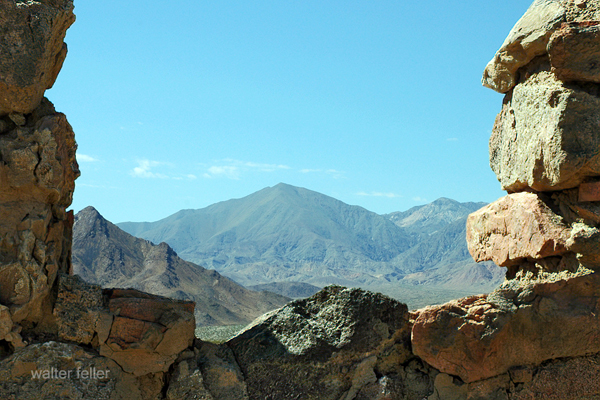
The earliest recorded gold discovery in San Bernardino County occurred at Salt Springs, at a point on the Santa Fe-Salt Lake Trail (Old Spanish Trail). Persistent rumors have it that gold was panned in the gravel near here by the Mexicans that passed through in the lucrative trade between Santa Fe, New Mexico and Los Angeles from 1826 until it ceased in 1848. In December, 1849, a Mr. Rowan and other members of a party of Mormons led by Jefferson Hunt discovered a quartz vein in a small canyon near the spring, in which they found nuggets, the largest about the size of a pea. In 1850, Frank Soule, later a state senator, relocated the gold deposit and took some samples back to San Francisco, where he organized a company that never developed. A Mormon party headed to San Bernardino in December, 1850 met William T. B. Stanford (Phineas Banning's brother-in-law) near the present site of Daggett, as he was hauling a mill to Salt Springs. Reportedly Ben Sublette, a "noted mountaineer" worked the mines from 1850 to 1852 with great success. However, after several men were killed by Indians, he abandoned the enterprise. 3

The mines were deserted from 1853 through 1859, but in September 1860, a Los Angeles company employed 30 men and had 3 arrastres running. Shortly before this, Charles Crismen acquired the engine and boiler from the mill and hauled it into the San Bernardino Mountains, for use at a lumber mill. Also in 1860, placer ground was discovered about 2 miles away and the gravel was hauled in wagons to the springs, indeed an expensive way to placer mine.

In 1863, the Amargosa Gold and Silver Mining Company of San Francisco acquired the mines at Salt Spring and in the fall of 1863, they installed a new mill that "met with good success for over a year." The company, however, went broke and the mill was sold in a sheriff's auction to Augustus Spear. On October 29, 1864, news broke in Los Angeles concerning the death of three men who were caretakers at the property. One of the men, had been killed by Indians, and the mill had been burned. The other two men were found 20 miles away, having committed suicide by putting bullets through their skulls. Two months later on December 4, 1864, Dr. J. A. Rousseau's party passed the mine and saw the destroyed mill. There were 4 buildings standing at that time. 4

In the middle of the 1860s, a new company took over the mine and operated it successfully for a couple of months. Yet, even though they later were reported to have grossed $11,000 from one ore blast of two tons of ore, and during a period of one month, the five-stamp mill produced $58,000 in gold, in 1870 the property was idle again. 5
In September 1881, J. M. Seymore sold the mine at Salt Spring to the South Pacific Mining Company of New York. Rumor was that they intended to erect a twenty-stamp mill. In 1902, J. B. Osborne worked the mine. In a week's run of his five-stamp mill, $60,000 of gold was produced. A few years later, in 1909, Walter C. Mendenhall described the site as follows: "At the old mine there is a little canyon that descends sharply to the north, in which are the ruins of a twenty-stamp mill. Near the mill are two wells, protected by curbing and covered..." About 1920 another company attempted to reopen the mine, but after spending a great deal of money they abandoned the venture and sold the mill in 1939. 6
Salt Creek ACEC

