Pinyon-Juniper Woodland
At higher elevations of the Mojave—especially on cooler, north-facing slopes—pinyon pine and juniper cling to shallow, rocky soils. The result is an open woodland: not a dense forest, but a spaced canopy that casts patchy shade and creates pockets of cover, food, and nesting structure for wildlife.For centuries, pinyon nuts have been an important food source for Native peoples and for wildlife. Later settlers and ranchers also used this woodland in practical ways. Juniper’s durable wood was commonly cut for fence posts, and in some ranges you can still find traces of old fencelines near abandoned homesteads and historic ranch sites—quiet reminders that high-country resources mattered in an otherwise dry region.
Beneath the trees, the understory often includes sagebrush and goldenbush, along with Mojave prickly pear cactus and spring wildflowers such as Indian paintbrush. This is a good place to slow down and listen. Scrub jays are common here—blue, but not crested—and antelope ground squirrels often announce themselves with quick, darting movement between rocks and shrubs.
In the higher ranges, desert bighorn sheep may appear on steep, broken slopes. Their hooves are adapted for traction on rock, which helps them move through terrain that keeps many predators at a distance. Bighorn are most often seen near water sources, where they come to drink and feed on grasses and other plants, then vanish back into the ridgelines with an ease that looks almost effortless.
| GLOSSARY | > HABITAT |
Indian use of Pinyon-Juniper Woodlands
Archaeological data and ethnographic accounts testify of the importance of resources available in the pinyon-juniper woodland to native peoples since the early ...Pinyon-juniper - Ecosystem
(PJN) Pinyon Species, Juniper Species, Mountain Mahogany Species Vegetation Structure-- Pinyon-juniper (PJN) habitat typically is an open woodland of low, ...https://www.fs.usda.gov/database/feis/plants/tree/pinmon/all.html
Juniper - California Juniper
California juniper is distributed from Shasta County, California, south as far as Baja ... California juniper most commonly occurs in pinyon-juniper woodlands that ...Pinyon-Juniper Woodland: Mojave Desert Plants
An open woodland composed of pinyon pines and junipers occurs above 4,500 feet elevation where they can receive over 10 inches of precipitation annually, ...Pinyon Pine
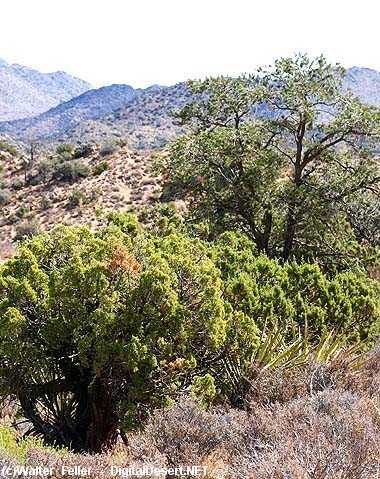
Pinyon and Juniper trees - Joshua Tree National Park
Particularly on north-facing slopes pinyon and juniper trees cling to shallow, rocky soil.
Pinyon nuts have long provided food for humans and wild animals.
This habitat includes sagebrush, goldenbush, wildflowers such as Indian paintbrush, and Mojave prickly pear cactus. Also look for scrub jays--blue but not crested--and antelope ground squirrels.
Also in the high elevations, bighorn sheep can be found. These are a wild sheep that feed on grasses and other plants. They are best spotted near water sources. Hooves adapted to steep, rocky terrain allow them to escape predators such as mountain lions.