Pioneer
Sheldon Stoddard
Monument Builder, Mail Carrier, Trail Blazer
Sheldon Stoddard, of San Bernardino, was born near Toronto, Canada, February 8. 1830, the son of Nathaniel and Jane MacManigal Stoddard. His
father was a carpenter by trade and a native of Massachusetts; the mother was born in Glasgow, Scotland. The father died at Toronto and the
mother came to the United States about 1838 with her four sons and after a year in Ohio located at Warsaw, Illinois. She crossed the
plains to Salt Lake and then to San Bernardino with the colonists of 1851, returning to Utah about 1875. Of the sons, Arvin and Albert
came to California in 1849. Rufus died in Utah in 1904. Sheldon Stoddard started for California in 1848, coming by way of Council Bluffs
and the North Platte route to Salt Lake. Here a party of about thirty men, under the guidance of Captain Flake, started for the placer
diggings in 1849. Among the members of this party were Charles C. Rich, George Q. Cannon, William Lay, and Sheldon Stoddard. They rode
pack animals and followed a trail as far as
Mountain Meadows, intending
to take a northern route via Walker's Lake to the placer diggings. They traveled westward for eighteen days without guides, compass or
maps. They found no water, and were saved from perishing by a providential shower that seemed to come from heaven to restore and save
them from a terrible death, famishing for the want of water, a miraculous escape for which blessing they all returned gratitude to
their Heavenly Father.
The water they caught by spreading their rubber blankets and drank it with a spoon. Being thus refreshed they turned eastward and struck
the head of the
Muddy River
which they followed down until they found a trail and soon afterward came up to
Captain Hunt
in camp with seven wagons that had remained with him when the rest of his party had taken the route that led them into
Death Valley, where
so many perished for the want of water. They came on southerly up the
Mohave River, through
the
Cajon Pass, and
reached Chino Ranch, where they remained for a month recruiting their stock and were hospitably treated by Col. Isaac Williams. They
went on to the Mariposa mines, where the company disbanded, and Mr. Stoddard established a trading post in the
Carson Valley to supply incoming immigrants. Flour and bacon sold for one dollar a pound, and other articles in proportion. Finally
he and his party bought about sixty horses and twenty head of mules and returned with these to Salt Lake.
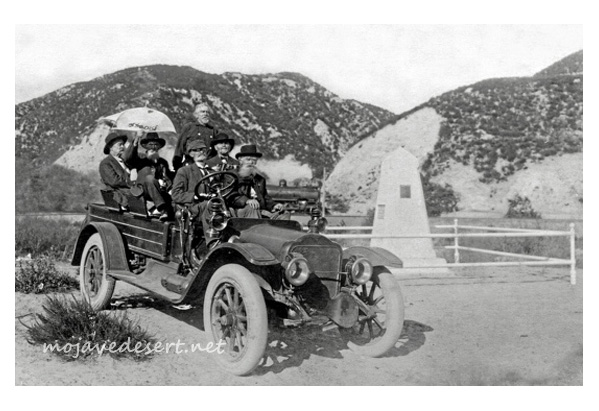
Stoddard-Waite Monument dedication ceremony, 1913. In the automobile are pioneers Sheldon Stoddard, Sidney Waite and unidentified others
In March, 1851, Mr. Stoddard married Miss Jane, the second daughter of Captain Hunt, and in April they started for California with
the San Bernardino colonists under Captain Hunt, Amasa Lyman, Charles C. Rich. At
Bitter Springs
Lyman, Rich, Hopkins, Rollins and Captain Hunt started on ahead of the company on horseback, Stoddard accompanying them with a
mule team, arriving and camping at Sycamore Grove, the remaining wagons reaching this location soon afterwards, where all remained
until September, 1851, when all moved down to the valley as the leaders had completed the purchase of the San Bernardino Rancho
from the Lugo family. Mr. Stoddard at once built the first log cabin out of willow logs on what was known as the Mary Carter place,
on First Street, west of I Street. This cabin was later taken down and moved down and erected on the west line of the fort that was
being constructed as a protection from hostile Indians. In May, 1852, he brought John Brown and family from San Pedro and located
them as his neighbor on the west side of this fort. Mr. Brown purchasing the cabin from Marshall Hunt for fifty dollars. In
1853 Mr. Stoddard built a small adobe house on the northwest corner of D and Fourth streets, where the postoffice is now
located. For many years he was engaged in freighting and carrying the United States mail between San Bernardino
and Salt Lake City, crossing the desert twenty-four times, in 1865 he made the trip to Nevada and Montana, a distance of 1,300 miles,
requiring six months for the journey, with his mule team. In 1882 he entered the employ of the California Southern Railway, and
the Santa Fe Railroad Company, under their chief engineer, Fred T. Perris, taking charge of their teaming and quarry work, retiring
in 1899 from active work to enjoy a well-earned rest. His beloved wife died in San Bernardino, December 26, 1899, since which time
he continued to live at the old home, Tenth and D streets with his daughter, Hattie Stoddard Merritt, who cared for him as only a
loving daughter knows how until his death, which occurred in 1903. He was elected president of the Pioneer Society to which he
was strongly attached as it kept him in touch with many of his old friends. He was active in building log cabins and monuments
with the pioneers and loved to go camping and fishing with them. Among these companions in later years
were Sydney P. Waite, John Brown, Jr.,
Bill Holcomb,
George Miller, George M. Cooley, Taney, Woodward, Richard Weir, Silas Cox, Jap Corbett, G. W. Suttenfield, Charley Clusker,
and others.
His children were Mary Aurelia, who married Nelson Sleppy, now deceased; Eva, who married Albert Rousseau, now deceased; Bell, now
deceased, and Hattie, wife of S. P. Merritt, now (1922) living.
by JOHN BROWN, Jr. & JAMES BOYD
Notes: HISTORY OF SAN BERNARDINO COUNTY
Sheldon Stoddard carried the mails during 1854 and took the last mail through in 1858. The mail was sent once a month, two men starting from each end of the route and meeting in the vicinity of the Muddy. The trip usually occupied about twenty days, although Mr. Hunt and a companion once made the journey in sixteen days—under the stress of an attack by the Indians and a flight from danger. Often pack horses and passengers accompanied the mail carriers.
In March, 1851. Mr. Stoddard married Miss Jane, the second daughter of Captain Hunt, and in April' they started for California with the San Bernardino colonists. At Bitter Springs, Lyman, Rich, Hunt, Hopkins and Rollins started on ahead of the company on horseback, and Stoddard accompanied then, with a mule team. They spent about twenty days in prospecting the country. In September Mr. Stoddard built the first log cabin within the town plat on what is now the Carter place, on First street west of 1 street. This cabin was later taken down and built into the west barricade of the fort. In 1S53 he built an adobe house on the northwest corner of D and Fourth streets, now occupied by the Lloyd Block, the present postoffice. This house stood until about 1870. In 1857 Mr. Stoddard removed to a ranch on Warm Creek. For many years he was engaged in carrying mail and freighting between San Bernardino and Salt Lake and other points. He crossed the desert twenty-four times with mail to Salt Lake and return. His last trip, in 1858, was an adventurous one. He, with Dan Taft and Louis Newell, started for Salt Lake with two wagons, four mules on each, carrying mail and freight. At Cottonwood Springs, 18 miles this side of Las Vegas, then a Mormon fort, they encountered an Indian and squaw at the point where they camped for dinner. They gave the Indians some bacon and biscuit and finally presented the buck with a cigar. They went on, leaving the Piutes in camp. The Indian, after smoking the cigar, was taken violently sick. The squaw, believing that the white men had intentionally poisoned her lord, started at once for a camp of about fifty Indians beyond Las Vegas. This party made a raid on the Mormon camp and told their story to the four men who were in the fort. The men with difficulty persuaded them to wait until the mail party arrived and they could find out whether the Indian was dead. When the San Bernardino party reached the fort they found a threatening outlook, but the Indians finally agreed to take a white man with them and go back and find the sick Indian. They met him coming in, better but still squeamish, and the Indians were still not satisfied that he had not been poisoned. It was finally arranged that the mail carriers were to give them six pairs of blankets and promise that if the Indian died they would give a horse. Then they were allowed to proceed, but they went on in much uneasiness, feeling that if the man should die it would furnish all the excuse the Indians wanted for an attack.
In 1865 Mr. Stoddard made the trip with a freight wagon to Nevada City, Montana, a distance of 1300 miles, the journey occupying six months. His last long freighting trip was to Pioche City, Nevada, in 1866. He continued to freight in Southern California- until 1882, when he entered the employ of the California Southern railway, taking charge of their teaming and quarry work. He remained with the railway company until 1899, when he retired from active life to enjoy the well-earned rest that is fitting for long and well spent years of labor. He has a comfortable old homestead, now a part of the city. His wife died December 26, 1899. Their children were: Mary, now the widow of N. Sleppy; Eve.: Mrs. Albert Rosseau, now deceased: Hattie ; Mrs. S. p. Merritt, and Bell, deceased.
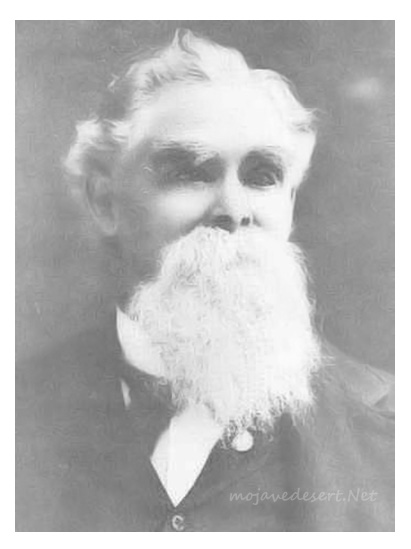
Sheldon Stoddard